Category Archives: Action

Deadly Force (1983)

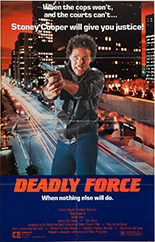
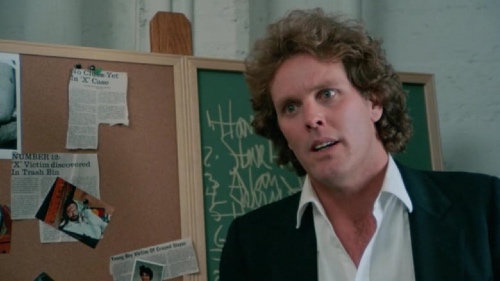
Los Angeles is under the hysteria-ridden spell of a serial killer in what the press dubs “the X Murders” case, so named for the letter left behind in the foreheads of the dead. Per usual in these things, the police are baffled, when a personal connection to victim No. 16 brings back one of their former own — disgraced cop and expert alcoholic Stoney Cooper (Wings Hauser) — from his busy life in New York, playing sidewalk games of rat roulette and bouncing his soccer ball in doggie droppings.

The only person less enthused than LAPD Capt. Hoxley (Lincoln Kilpatrick, 1987’s Prison) to see Stoney in town is his estranged wife, Eddie (Joyce Ingalls, 1975’s The Man Who Wouldn’t Die), now a TV news reporter. However, one of those two will end up boning Stoney in a hammock before the movie calls it quits.

Deadly Force marks a veritable Vice Squad reunion between Hauser, producer Sandy Howard and co-writer Robert Vincent O’Neil (soon to bring us Angel). This doesn’t near the jolt of their ’82 sleaze classic. How could it? As a solo-vehicle attempt to get Wings off the ground, however, it could be worse. With hair that makes William Katt’s look comparatively subtle, Hauser works his baby face to his advantage. His screen presence makes winsome what less-amiable actors might turn into an asshole.

The only point he risks that goodwill is when his sex scene with Ingalls ventures one tongue flick to the nipple too explicit. That move is more unexpected than director Paul Aaron (A Force of One) employing a sub-Magnum P.I. score as an onomatopoeia, but less expected than a cameo by Golden Girl Estelle Getty as a cabbie who’s — get this! — grouchy. —Rod Lott

Get it at Amazon.

Perdita Durango (1997)

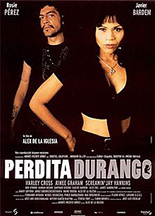
From a dark and dirty novel by Barry Gifford, Perdita was originally a minor character in David Lynch’s Wild at Heart played by Isabella Rossellini. In Alex de la Iglesia’s dark and dirty film Perdita Durango, however — originally released in the States as the heavily edited Dance with the Devil — it transforms her sweltering story in a diabolical masterpiece that, like many of his films, deserves a rabid cult surrounding it.

Rosie Perez stars as the double-dealing Perdita, a damned soul who wanders south of the border looking good in her Faster, Pussycat! Kill! Kill! outfit while searching for — and always finding — sex, drugs and murder. She meets her infernal match when she comes upon — and on — drug dealer and cult leader Romeo (Javier Bardem). After a rather bloody Santeria service, looking for hardcore kicks before their next score — a semi full of aborted fetuses to be used for cosmetics testing — they kidnap two white-bread teens from America.

Going further than Lynch probably ever could or would — and fans know how far he’ll go — de la Iglesia’s wicked hand fleshes out, in more ways than one, the black soul of the title character, never excusing her inner darkness like any filmmakers probably would have done, giving her a heart of gold. The casting of Perez is perfect for the film and, probably, for de la Iglesia himself, maiming and killing for laughs and looking good while doing it.

Bardem as Romeo, of course, is absolutely loathsome as you’d expect, a terrific foil with an evil glimmer in his eye for an equally filthy — and wholly diverse — supporting cast that includes James Gandolfini, Demian Bichir, Alex Cox and Screamin’ Jay Hawkins. It’s a collection of actors as dark and wild as the world of Durango herself. —Louis Fowler

Get it at Amazon.

Strike Commando (1986)

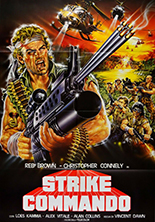
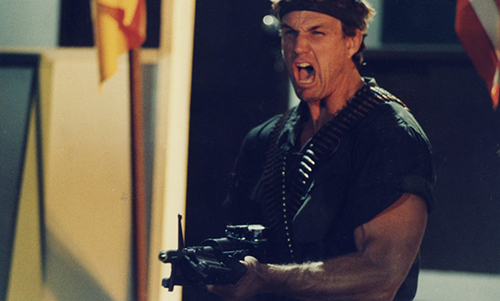
Strike One to SAT Eagle! Strike One to SAT Eagle! As Sgt. Michael Ransom, Strike Commando star Reb Brown establishes a four-step schtick for not only his wronged-soldier character, but for the apex of his filmography. It goes a little something like this:
1. Walk a few steps before halting with purpose.
2. Recite the first name of thy enemy with anger.
3. Emit a scream as prolonged as possible …
4. … as you unload a machine gun in a back-and-forth motion to an excessive degree — ideally in equal time to item No. 3.

It works every time. He executes this bit several times throughout Strike Commando because it’s what Sly Stallone’s John Rambo would do, and Strike Commando could not exist without that big bowl of First Blood Part II. As staged by Italy’s primo cinema imitator, Bruno Mattei (Cruel Jaws), Ransom vows revenge on his traitorous superior, Radok (Christopher Connelly, 1990: The Bronx Warriors), for sabotaging a midnight mission in Vietnam that left all Ransom’s buddies dead.

“They all demand justice!” Ransom cries, clearly in a presumption on his part.

Radok thinks Ransom is no longer alive, either, but our hero somehow survives and somehowier slowly floats his way under miles of dirty water to the safety of a village whose populace greets him in mass whiteface. There, Ransom befriends a “Frenchman” (Luciano Pigozzi, the Italian Jack Elam, reuniting with Brown after Yor: The Hunter from the Future) and gains a li’l buddy in the boy Lao (Edison Navarro, Mattei’s Double Target). Lao quizzes Ransom on all things Disneyland; the American tells his young charge that at the park, popcorn and ice cream grow on trees. The fuck they do!

As with everyone Ransom so much as glances at, these poor saps soon are drained of their lifeblood as well, with Lao’s expiration an absolute classic of ’80s he-man cinema. With these deaths at the doing of Russian meat slab Jakota (Alex Vitale, Beyond the Door III), Ransom gains two opponents, and our one movie is all the better for it, affording us a thrifty montage of Ransom undergoing various acts torture; as viewers of the DVD-multipack-bin “favorite” The Firing Line know, these are the type of scenes in which Brown gives it his all.

While he lacks acting skills, Brown gives the movie something — something I failed to notice until watching Mattei’s 1988 follow-up, Strike Commando 2, in which Ransom is played instead by human blank Gwendoline’s Brent Huff. With this switcheroo, the sequel is such a snore, it needs a CPAP machine. Venture no further than original-recipe Strike Commando and all of its Rebness. As Joni Mitchell warned — and we ignored, so Counting Crows and Cinderella had to remind us — you don’t know what you’ve got ’til it’s gone. Also, there’s cockfighting. —Rod Lott

Get it at Amazon.

Sharks’ Treasure (1975)

More than one shark flick swam into theaters in 1975. Released a few months later than that other one was Sharks’ Treasure, the final film of the do-it-all director Cornel Wilde (The Naked Prey). Far from delivering an iron-hot cash-in, the aging auteur approached the oceanic adventure the only way he knew how: utter earnestness. So earnest is the film, Oscar Wilde — no relation — would look at it, nod his head and say, “Important.”

William Grefé’s Mako: The Jaws of Death, this is not.

Crusty skipper Jim Carnahan (Wilde) is approached by a young man (John Neilson, Terror at Red Wolf Inn) about chartering his boat to a spot where a Spanish galleon’s gold is rumored to be sunk in the sands of the Caribbean floor. After an initial and impulsive turndown, Carnahan agrees and takes out a dangerously large loan to fund the mission. Among the hired crew is a Black Irish diver (Yaphet Kotto, Across 110th Street).

As the title has it, the waters between the boat and the loot are shark-infested. And as the title doesn’t have it, sharks aren’t the dominant threat. That honor belongs to a dinghy full of escaped convicts who, led by the appropriately named Lobo (Cliff Osmond, Sweet Sugar), hop aboard to hold our heroes hostage. Still, if you don’t think the threats won’t overlap, you’re chum.

Featuring sharks and otherwise, the underwater footage is real and it’s spectacular — not a surprise when you consider the man-vs.-nature themes of Wilde’s No Blade of Grass and the aforementioned Naked Prey. While the fearsome finned fish clearly were the front-and-center selling point of Sharks’ Treasure, the movie would be compelling enough without it. With a character like Wilde on hand to scowl, bark and show off his sexagenarian physique — including a pre-Palance demo of one-handed push-ups, it would be hard not to. —Rod Lott

Get it at Amazon.

Nobody (2021)

Hutch Mansell leads an unremarkable existence. Married with two kids, his days are a blur of the mundane and the predictable. He works as an accountant for his father-in-law in a small manufacturing firm. The only suspense in his life comes on days he must hustle to get the trash curbside in time for the garbage truck. Hutch is a nobody.

At least that’s what he would have us believe. But the nobody at the heart of Nobody is portrayed by Bob Odenkirk, and as the actor has proved many times over in TV’s Breaking Bad and Better Call Saul, he can be a damned compelling presence.

Hutch’s routine is forever uprooted one night when two masked intruders break into the Mansell home. Hutch arms himself with a golf club, but chooses not to escalate the situation, instead allowing the thieves to get away. That decision doesn’t sit well with his wife (Connie Nielsen, Wonder Woman 1984) and teenaged son (Gage Munroe), who interpret Hutch’s action as cowardice and treat him coldly afterward.

What his family doesn’t know, and we learn soon enough, is that Hutch has a secret past as an ex-military assassin. The home invasion awakens his old habits, however, particularly on a city bus when he sees a group of hoodlums threatening a young woman. In an inspired choreography of ultraviolence, Hutch pulverizes the baddies, including one who turns out to be the younger brother of Yulian Kuznetsov (Aleksey Serebryakov), a psychopathic killer in the Russian mafia.

Screenwriter Derek Kolstad and co-producer David Leitch, both of the John Wick franchise, infuse Nobody with brutally effective violence and a grim sense of humor. If the movie doesn’t quite match Wick-actioner standards, neither does it embarrass itself. Director Ilya Naishuller (Hardcore Henry) breaks no new ground, but helms with the cool efficiency of an acupuncturist who knows what pressure points will satisfy action-flick fans. It works, if perfunctorily, from the contrived plot devices (why exactly does the entire Russian mafia appear to be headquartered in the United States?) to a smattering of pop songs that provide ironic counterpoint to blood-spattered mayhem.

Best of all is Bob Odenkirk. The 58-year-old former sketch comedian turns out to be a credible tough guy. The film offers some other nifty casting choices, particularly Christopher Lloyd (Back to the Future’s Doc Brown) and rapper RZA (The Man with the Iron Fists) as Hutch’s father and brother, but Odenkirk’s rumpled charisma is what ultimately makes Nobody worth knowing. —Phil Bacharach

Get it at Amazon.