
All posts by Rod Lott

Screens of Blood: A Critical Approach to Film and Television Violence

screensofbloodIn his introduction to Screens of Blood, the Colorado-based Gregory Desilet writes that his book-length examination of violence of screens both silver and small does not approach the subject as harmful or harmless. That would be a most welcome perspective if it were true, but time and time again, the author appears to err on the politically correct side of harmful.

After all, according to him, watching crime shows on TV is bad for you — and not only for your health, but that of your community at large: “Fans of the Dexter series … must weigh what viewing does for them against what it does to them.” Who wrote this, James Dobson?

It’s not that Desilet never raises any valid points. He does, such as when questioning why Jodie Foster would involve herself in Neil Jordan’s 2007 vigilante thriller The Brave One when she has tried for decades to distance herself from the John Hinckley situation, but those points are overshadowed by so many more ridiculous ones.

Topping the aforementioned Dexter comment are his takedowns of Breaking Bad for training future criminals and 24 for breeding potential terrorists. These taint the book as a knee-jerk screed instead of the unbiased, intelligent discussion it could have been and presents itself to be.

He takes Quentin Tarantino to task for Django Unchained, but in a move of juvenilia for an academic work, imagines the filmmaker’s thought process for the epic’s amount of bloodshed. Your honor, I move that Exhibit A be found inadmissible for reasons of inanity.

Desilet further discredits himself simply by exposing poor taste in general. Even die-hard Martin Scorsese fans will admit that Shutter Island is far from “one of [his] best films.” The author seems less concerned with the violence in the 2010 Denzel Washington vehicle The Book of Eli than trying to convince us that the much-derided post-apocalyptic movie is great. In praising HBO’s The Sopranos, which is perfectly understandable, he goes out of his way to let us know how 1967’s groundbreaking Bonnie and Clyde “fails,” which is not.

I realize that whether a film is considered “good” or “bad” is not the point of Screens of Blood, but in this case, it’s impossible to ignore. —Rod Lott

Buy it at Amazon.

Terror in the Haunted House (1958)

terrorhauntedIronically, the element that attracts most viewers to Terror in the Haunted House is the very thing they’ll care the least about: its “Psycho-Rama” gimmick of subliminal images. There’s a devil head here, a snake or skull there, but nothing worth writing tweets about. Instead, the story supplants cheap novelty and pulls you in, whereas we’d expect the opposite.

Life is ever so keen for the just-married Sheila (Cathy O’Donnell, Detective Story), if not for the fact that she is plagued by nightmares of an old house to which she swears she’s never been. She always awakes before she reaches the attic, where she’s certain “death in its most hideous form” awaits; in Switzerland, her shrink (Barry Bernard, Return of the Fly) believes her subconscious is shielding her from some heinous act in her past that she cannot remember.

terrorhaunted1Oh, well, so much for that breakthrough, because it’s off to Florida with hubby Philip (Gerald Mohr, The Angry Red Planet)! “I’ve got everything,” Sheila says, “tickets, passports, money, smallpox certificates.” Arriving in the Sunshine State, Philip drives up to their new rental home and … wait for it … it’s the one from Sheila’s dreams! Let the family curses and falling chandeliers begin.

O’Donnell has the part of the Meek and Subservient Newly Mashed Cherry down pat enough to carry us through an hour and some change. She does more for Terror in the Haunted House (aka My World Dies Screaming) than the flat direction from Harold Daniels (Roadblock). The script by Robert C. Dennis (The Amazing Captain Nemo) contains some nifty twists, but the exposition-filled end makes Psycho‘s look like the definition of brevity.

As for those subliminal frames, flashing messages such as “GET READY TO SCREAM!” and “SCREAM BLOODY MURDER!” kind of kills any intended shock effect. Luckily, Terror‘s power source is rooted in the psychological. —Rod Lott

Buy it at Amazon.

The Hunger Games: Catching Fire (2013)

catchingfireFrancis Lawrence (Constantine) didn’t have to work too hard to clear the bar Gary Ross set in 2012 with the dull adaptation of The Hunger Games. I wish he had anyway, because Catching Fire does just that only about halfway in, and then never roaring.

Assuming audiences have digested the previous film and its Battle Royale of a plot, Catching Fire catches Katniss Everdeen (Jennifer Lawrence, American Hustle) and Peeta Mellark (Josh Hutcherson, 2012’s Red Dawn remake) ditching their potato-sack wardrobe to embark on a victory tour of the nation’s 12 districts and sell the illusion of a romance to the huddled masses. Instead, they deviate from the government script and Katniss becomes a “beacon of hope for the rebellion. She needs to be eliminated,” orders nefarious President Snow (Donald Sutherland, Space Cowboys).

catchingfire1To do that, Snow forces the pair into another round of Hunger Games, this time an all-stars edition planned by Plutarch Heavensbee (Philip Seymour Hoffman, The Master). As Head Gamemaker for the Capitol, he creates a deadly beach scenario full of such frights as angry monkeys, blister smoke and Amanda Plummer.

Once Lawrence — the director, that is — gets his young stars into combat, the movie becomes mild fun to watch. Before that, it’s almost as bland and plodding as Ross’ work, which mistook its dystopian setting as a mandate that it also couldn’t have a soul. Dozens of characters with names that sound like failed foreign breakfast cereals return, but Mr. Lawrence is able to inject the proceedings with more juice. Too bad his leads remain ever languid.

The one thing that the original The Hunger Games had that Catching Fire does not is an actual ending. What viewers get here is not just a cheat, but a bout of expository diarrhea. It is possible to give a story closure while leaving some threads dangling for the next chapter; this one is all damned dangle. —Rod Lott

Buy it at Amazon.

Investigation of a Citizen Above Suspicion (1970)

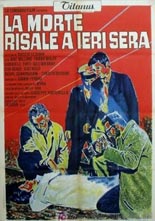
investigationcitizen“How are you going to kill me this time?” she asks teasingly, as she takes her lover into her arms.

“I’m going to slash your throat,” he answers his mistress, welcoming the embrace.

As they undress and slide under the silk sheets, he makes good on his playful threat. That the man actually kills her is one shock. That he is also the chief of the police’s homicide division is another.

Never named, the inspector (Gian Maria Volonté, A Fistful of Dollars) is worshipped by the officers below him, whereas they view the deceased Miss Terzi (Floridan Bolkan, A Lizard in a Woman’s Skin) as “a libertine” for owning no undergarments. Then again, Investigation of a Citizen Above Suspicion takes place in an era when Italy kept secret files on homosexuals and communists alike, which the inspector lords over as potential blackmail material, so the authorities are all about snap judgments.

37.tifPreaching precision and repression, he embarks on the investigation of Terzi’s murder despite being the crime’s perpetrator. He even leaves a slew of clues at the scene that point directly to him. Why? He feels he is so above the law, he never could be taken seriously as a suspect. He even informs his superior of his affair with the woman.

Investigation is not your ordinary Italian thriller, and not just because it won the Academy Award that year for Best Foreign Language Film. It is built with a heavy streak of political satire, some of which may be lost on American viewers, but hardly to a point of indifference; the mystery of the inspector’s mental state is too great a pull, and director Elio Petri (The 10th Victim) parcels out explanatory bits during many flashbacks.

Technically, the movie is imperfect — the camera shakes in the pivotal moments right after the crime, and later, the crew clearly is reflected in our antihero’s sunglasses — but all that can be overlooked with ease because its plot is so unique, even several decades after the fact. Sporting the bounce of a plucked rubber band, Ennio Morricone’s equally first-rate theme strongly hints at Petri’s playful intent, dark though it may be, dark it should be. —Rod Lott

Buy it at Amazon.

Golden Needles (1974)

goldenneedlesTo grant Golden Needles the alternate title of Mitchell Goes to the Orient — as a friend of mine did — is not out of line, even if Mitchell was a year away from its messy birth. This half-baked adventure presents star Joe Don Baker (Walking Tall) in the same vein: overweight, unkempt, presumably sweaty, kinda dumb and yet somehow wholly desirable to women out of his league. Imagine the guy who runs your grocery store’s produce department strutting around like he were George Clooney, and that’s Baker as Mitchell Dan.

The Golden Needles of the title refer not to what viewers will want to stab into their eyes upon the requisite sex scene, but the magic acupuncture statue that damn near everyone wishes to acquire. An American woman named Felicity (Elizabeth Ashley, Coma) attempts to buy the stolen statue in Hong Kong, but her offer is turned down. Her solution is to hire Dan, whom she just met at a brothel, to steal it for her. “That must be a bell-ringer of a statue,” he says.

goldenneedles1Damn straight it is! If its needles are placed in the proper order, it grants “sexual vigor” to the poked! Although supposedly retired, Dan agrees if Felicity will hug him and say “I love you” to him right then and there. Dan has mommy issues, so Lord knows why the refined Felicity decides to sleep with him. He kisses as if her face were a roast beef platter; fittingly, their postcoital activity is stuffing themselves with seafood. You’ll swear off seafood.

Golden Needles is an action movie, although one might forget that fact while watching. It has two fun chases — one through a health spa; the other, a shipyard — and the brief moments that Jim Kelly (Black Belt Jones) is onscreen busting out kung-fu moves are blessed ones. While watching the Hulk-esque act of Baker throwing Asians through plate glass never gets old, the movie does. That Robert Clouse went from the martial-arts classic Enter the Dragon to this obscurity in less than a year says more about the talent of Bruce Lee. —Rod Lott

Buy it at Amazon.