
All posts by Rod Lott

The Creep Behind the Camera (2014)

creepbehindMatching in ambition, Pete Schuermann’s The Creep Behind the Camera would make a good double feature with Tim Burton’s Ed Wood. I only wish it shared the latter’s focus and greatness.

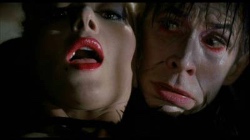
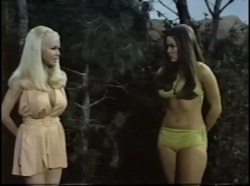
A mix of documentary footage and fictionalized re-enactments, The Creep Behind the Camera chronicles in part the production of The Creeping Terror, generally and rightly considered to be one of the worst films ever made. The 1964 cheapie is, as one of this film’s interviewees puts it, “a very low-budget movie made by a very psychotic person.” The madman in question is Terror’s director, producer and star, Art “A.J.” Nelson, better known as Vic Savage. By all accounts a big ball of sleaze, Savage is portrayed with a predatory, slime-dripping smile by Josh Phillips (Text), in a durable performance that seems to channel early-career Bill Paxton.

creepbehind1A former juvenile delinquent who never quite grew up, the bisexual Savage (who died in 1975) hustles and schemes and cheats his way through life and into grandiose dreams of Hollywood fame. That he has no discernible talent outside of fleecing others and abusing his long-suffering wife (Jodi Lynn Thomas, TV’s Preacher) hardly deters him.

Overall, this tale of monsters, mobsters and Manson (yes, as in Charles) is at its best and brightest when either recreating or commenting upon the tortured shoot for The Creeping Terror, with its shambling creature of carpet scraps looking to extras not unlike giant labia. Savage’s disasterpiece was a natural for its eventual experimentation on Mystery Science Theater 3000, given that the black-and-white pic relied more on narration than dialogue, not to mention solicited a music score from a high school band; not for nothing does critic and Golden Turkey author Michael Medved say to Schuermann’s camera, “You will never see incompetence more sincere.” Other greatest bits depict Savage’s crazier off-set antics, from shooting Carl “Alfalfa” Switzer through the hand to stalking Mamie Van Doren and Lucille Ball (although not at the same time).

One has to appreciate Schuermann’s unique take for The Creep, even if the timeline can be janky and the narrative ultimately derails in the second hour. Utilizing more interviews would have helped sweeten the utterly sour turn in tone from lighthearted schlock to downright depressing, because that third act is so relentlessly glum and humorless that the viewer is worn into a state of despondence as well. —Rod Lott

Get it at Amazon.

Batman: Return of the Caped Crusaders (2016)

batmanrotccPresumably without knowing, the sheer campiness of the beloved Batman live-action TV series of 1966-68 helped perpetuate the myth of Batman and Robin being homosexual lovers. Fifty years later, this animated feature spin-off has no designs on setting the record, er, straight; it opens in Wayne Manor, with young Dick Grayson practicing ballet moves in front of a roaring fire. Holy pas de deux, Batman!

Reuniting Adam West and Burt Ward — if only their voices — as the respective cowled detective and his Boy Wonder sidekick, Batman: Return of the Caped Crusaders pits Gotham City’s finest crimefighting duo against a foursome of their most fearsome foes: The Joker, The Riddler, The Penguin and “that dominatrix of deviltry,” Catwoman. The latter is voiced by Julie Newmar, one of three actresses to have filled that catsuit opposite West in the show and its 1966 big-screen adventure — a fact this film acknowledges with a wink as a noggin-conked not-so-Dark Knight sees her in triple vision, yet two of them look remarkably like Lee Meriwether and Eartha Kitt. The movie is full of kitschy digs like that, such as commenting on why everything in the Batcave is labeled.

batmanrotcc1And yet, for how purposely and appropriately silly it all is, it left me cold. Wally Wingert may have Frank Gorshin’s Riddler laugh down pat (assuming it’s not sampled straight from the old show), but Return of the Caped Crusaders feels more like a fan film than a real-deal reunion, as if it exists purely to wring dollars from nostalgia rather than because there was a new story to be told. It’s not bad — it’s certainly not drawn that way — but I quickly grew tired of its unrelenting need to poke me in the ribs. To be reminded of the TV series this much, I’d rather just watch the TV series. —Rod Lott

Get it at Amazon.

Creepy Classics (1987)

creepyclassicsMade by Hallmark Entertainment — yes, the greeting-card company — in the VHS heyday and sold at its stores nationwide, Creepy Classics is one of many B-movie trailer compilations to emerge at the time. This one stands out for three reasons, only one of them good: that the legendary Vincent Price hosts. Not as positive is the 30-minute running time, although that keeps the proceedings from dragging; we’ll get to the remaining reason in a sec.

Among the previews our “Master of Scarimonies” (groan) introduces are the Amicus anthology Dr. Terror’s House of Horrors, Jack H. Harris’ Dinosaurus!, Freddie Francis’ The Day of the Triffids and Gorgo. (You know Gorgo, right? She’s the prehistoric sea monster whose baby is captured by “reckless skin divers.”) Price even touches on two of his own films, The Raven and The Pit and the Pendulum, both directed by Roger Corman. Every flick featured is from the 1950s and ’60s, except Oliver Stone’s The Hand — a decidedly odd outlier.

creepyclassics1As promised, the tape’s third and final distinction: It came packaged with a 10-question trivia quiz on a single card; the idea was to tackle it after the show came to a close to see if you were paying attention. It would tax no one. No classic of compilations, Creepy Classics is for Price completists only. —Rod Lott

Get it at Amazon.

Scary Tales (1993)

scarytalesShot on video in Baltimore, “Unitied States,” Scary Tales achieves 50% accuracy with its title, in that more than one story exists — three of them, in fact — yet none of what writer/director Doug Ulrich presents is even remotely frightening, except perhaps the men’s dated haircuts.

The opener, “Satan’s Necklace,” is about “no ordinary necklace — it’s Satan’s necklace!” Despite such a devilish pedigree, the cursed jewelry is found with a run-of-the-mill metal detector by a guy with more pockmarks than this movie has words. “Sliced in Coldblood” is your very basic tale of a husband going full-on nutso upon learning he’s being cuckolded; one of the victims of his resulting murder spree is a beer-swilling, Foodtown cap-clad schlub on whose cavernous belly button the camera dwells in increasingly nauseating close-up, yet blessedly not always in focus.

scarytales1Finally, like The Lawnmower Man on $1.98, we enter “Level 21,” in which a man obsessed with a new video game (whose screens we are not privy to) gets sucked into it. The fantasy world of the game looks like a neighborhood greenbelt, but populated with a dwarf, an orc in a bald cap and one “dark overlord” clad in a purple cloak and sporting the widow’s peak made famous by Eddie Munster.

The less said about Scary Tales, the better — not because its narrative paths are laden with surprises aplenty (quite the opposite), but because at all of 68 amateurish minutes, it is too inconsequential to merit much discussion beyond saying what it is. Hey, I remember trying to make a Creepshow-style horror anthology with a VHS camcorder, too; my excuse is that I was 12 years old. I’m willing to bet my dialogue was better than “Hey, that Raisin Bran’s pretty good! Get a box,” but Ulrich does have one thing on me: the per-the-credits participation of “Dundalk Taco Bell.” —Rod Lott

Get it at Amazon.

In a Valley of Violence (2016)

invalleyFlying in the face of probability, Ethan Hawke has two Westerns in theaters at once: The Magnificent Seven and In a Valley of Violence. The difference? About $89 million and, here, Hawke screaming at a vulture.

Moseying away from the genre that established his often-brilliant career, indie-horror darling Ti West (The Innkeepers) saddles up for a simple tale of a Civil War vet en route to Mexico. Accompanied by his trusty attack dog (Jumpy, Pups United), Hawke’s Paul stops in the one-horse town of Denton, Texas (where the traffic has yet to suck), to sit a spell. The local bully, Gilly (James Ransome, Sinister 2), takes offense to this stranger not showing him the respect he believes he is owed, all because his bum-legged father is the town marshal (John Travolta, whose recent I Am Wrath revels in similar vengeful themes). Gilly and his yellow-bellied trio of lackeys commit two horrific acts of violence (true to the title), for which Paul vows revenge … assuming he lives through it.

invalley1There is not much to this Valley, which is entirely West’s intent as writer and director — not just here, but his work in general. The picture is streamlined, efficient — a straight-and-narrow cowboy’s hat tip to Sergio Leone’s Dollars trilogy of spaghetti Westerns, starting with co-opting its animated credits. It is John Wick set in the 19th century, trading neon for dust, business suits for boot spurs.

“Those men left me with nothin’,” Paul says. “I’m gonna leave them with less.” And the film shines as an example of less being more. While not totally giving up elements of horror (read: blood spurts and spills with gory aplomb), West proves his minimalist approach to visual storytelling works as well on the frontier as it does in provoking fright. Hawke is reliably strong, while Travolta is tempered from his tendency to ham. The pic, however, belongs to Ransome, stealing the spotlight as he adds another role of weaselly menace to his mantle. —Rod Lott

Get it at Amazon or Focus World.