All posts by Rod Lott

Hollywood Horror House (1970)

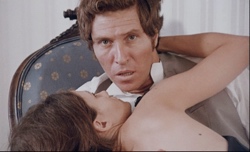
Years in the making, Hollywood Horror House (aka Savage Intruder) represents the singular vision of Donald Wolfe — its writer, director and producer — in his one and only feature. That he never made another is a damn shame, but perhaps it’s not for a lack of trying. This one, after all, was funded by his Movieland Tours business, a virtual ad for which bookends the film, as a bus pulls up long enough for the driver (The Three Stooges’ Joe Besser) to point out the old mansion up the hill and in disrepair.

There lives faded matinee idol Katharine Packard (the 1932 Dr. Jekyll and Mr. Hyde’s Miriam Hopkins, in her final role), her days now drowned in vodka, fairy-godmother gowns and clouded memories of being somebody. Off the tour bus hops homeless hippie Vic Valance (John David Garfield, White Line Fever) and gets a job as Katharine’s live-in caretaker. She’s thrilled to have such a handsome young man around; he’s thrilled to have lucked into a meal ticket, even if that means becoming her sexual plaything. It does.

Katharine is completely oblivious to Vic’s true self: a Satan-worshipping, smack-shooting serial killer who favors the electric carving knife. A former foster child, Vic projects his considerable mommy issues onto Katharine the more he undergoes drug-induced freakouts-cum-flashbacks, rendered onscreen in rather intoxicating kaleidoscopic visuals using every color of the Crayola box — the 64-count with built-in sharpener, of course. These effects are quite good, as are the practical effects depicting viscous torrents of blood jutting from lopped appendages.

A lot goes on under the roof of Hollywood Horror House, a real generation gap of a film. It’s a study in contrasts, particularly of artifice and honesty, starting with a shot of the glamorous landmark Hollywood sign, revealed to be heavily decayed as the camera switches to a close-up. No instance is accidental; hitting most wickedly is a family enjoying a Christmas parade while an L.A. business behind them advertises in bright orange-red letters, “TOTAL NUDITY.”

On that note, Hopkins briefly bares her sexagenarian breasts in one scene, part of her total commitment to a bravura performance, because if the one-time Academy Award nominee held any reservations about appearing in a B picture late in her career (Russ Meyer’s Fanny Hill being another), she doesn’t show it. In fact, given the awards success of What Ever Happened to Baby Jane? and Hush … Hush, Sweet Charlotte, it’s not out of the realm of possibility that Hopkins thought she had a solid shot at an Oscar nod.

Wolfe’s film is hagsploitation without the marquee name value. It’s also a nice surprise. The last half grows incrementally more sluggish as the cast thins … until Vic goes totally bonkers, and the movie willfully, wonderfully follows. —Rod Lott

Get it at Amazon.

Reading Material: Short Ends 5/23/20

In the same vein as his book on sci-fi and horror films of the same era, Mark Thomas McGee covers a decade’s worth of JD and other teenage-targeted movies with Teenage Thunder: A Front Row Look at the 1950s Teenpics. After a meaty introduction to the subgenre, McGee gets to the main course: full A-to-Z reviews of enough movies to fill a few swell jalopies, with Elvis Presley, Mamie Van Doren and Roger Corman turning up everywhere. Rather than quoting other critics to give context on the films’ reception, McGee instead quotes the actual exhibitors, which yields some lines as vicious as any from a poisoned pen; says one of Teenagers from Outer Space, “better to leave the house dark for three nights.” The BearManor Media paperback squeaks through with a few glaring errors (one “Capital” Records is forgivable; multiple instances of Dick “Clarke” are not), but the book is so much fun, it’s nearly essential. To borrow the tagline from the poster for Rock, Pretty Baby!, it’s the most! The greatest! It’s crazy, man, crazy!

Where were you in 1962? If you were alive, perhaps in a theater watching To Kill a Mockingbird, The Manchurian Candidate or any number of landmark films the year brought. With Cinema ’62: The Greatest Year at the Movies:, Stephen Farber and Michael McClellan make the case for those 12 months being an absolute peak for Hollywood celluloid. We’ve all heard similar claims laid for 1939 and, more recently, 1999, but 1962? Nope, never — not until right now. They don’t convince me — every year brings its share of four-star winners — but they do succeed in crafting a credible, critical narrative of an art form in transition, with chapters covering the foreign-film revolution, the loosening of sexual morals onscreen, the increasing influence of psychoanalysis and, naturally, the move from black and white to glorious Technicolor. In hardcover from Rutgers University Press, Cinema ’62 registers as a brainier take on Peter Biskind’s style, but not nearly as breezy and boisterous.

Spoiler Alert!: The Badass Book of Movie Plots is part screenwriting manual, part humor title and part graphic novel. From the minds of Stephen Espinoza, Kathleen Killian Fernandez and Chris Vander Kaay (the latter two of whom co-authored 2018’s Indie Science Fiction Cinema Today), the Laurence King Publishing paperback is nothing if not colorful. But it’s more than that, too, breaking down the beats of 38 film subgenres — e.g., Teen Sex Comedy, the Disaster Movie, the Superhero Origin Film, the Erotic Thriller, the Animal Attack Horror and so on — in three acts. The result is like a bunch of Mad magazine parodies of movies that don’t exist … except they kinda do! The authors have nailed the hundreds of clichés still permeating the pictures produced today. While the book is well-designed, its cutesy-verging illustrations belie the mildly wicked humor to be found in the word balloons. —Rod Lott

Get them at Amazon.

The Mandela Effect (2019)

A psych-101 Reddit thread drives the plot of David Guy Levy’s The Mandela Effect, referring to the phenomenon of “remembering” something that has never been true, whether it’s Curious George having a tail or the Monopoly man wearing a monocle. However insignificant these false pop-culture memories are in real life, they’re bestowed with literal life-or-death stakes in this screen telling.

Video game designer Brendan (Charlie Hofheimer, an alum of Levy’s Would You Rather) learns of the theory from his brother-in-law (Robin Lord Taylor, John Wick: Chapter 3 — Parabellum). Perhaps because Brendan is grieving the drowning death of his daughter (Madeleine McGraw, Ant-Man and the Wasp), he latches onto the theory with an unhealthy fervor. Before long, he’s stalking a college professor (Outland’s Clarke Peters, obviously a Morgan Freeman stand-in) who believes Brendan is witnessing the result of alternate realities colliding, and whose quantum computer can allow them to alter the world’s “code” so they can bring the girl back to life. Or something like that.

Providing no shortage of Big Ideas, Levy and his Would You Rather collaborator Steffen Schlachtenhaufen have the makings of a Matrix-style head-tripper, but the pertinent information to transition into that all-important third act is delivered with such immediacy (as opposed to urgency) that the climax feels rushed — which truly may be the case, as the film clocks in at a brief 80 minutes, credits included. Had Brendan and the professor looked before they leapt, so to speak, The Mandela Effect might have resonated with its intended power. Lost in that sprint is a late subplot about the mental state of Brendan’s wife (Aleksa Palladino, The Irishman), although she does pop back up just long enough to contract what looks to be a medical condition known in the field as Jenga Face.

The fun of the film is all upfront, if viewers know to look for hidden-in-plain-sight examples of the Mandela effect before the narration alerts you to them; it’s like playing Life magazine’s Picture Puzzle feature, in which readers are challenged to spot the differences between two photos. With paranoia brewing stronger as the story progresses, one wonders what a director with demonstrated skill in this arena before — say, Pi’s Darren Aronofsky or Primer’s Shane Carruth — could do with it. —Rod Lott

Get it at Amazon.

The McPherson Tape (1989)

One of the earliest found-footage movies, if not the earliest, Dean Alioto’s no-budget The McPherson Tape purports to document one family’s encounter with extraterrestrials on an evening in the fall of 1983. Despite the title, this clan’s surname isn’t McPherson, but Van Heese. The night that changes their life happens to coincide with their celebration of a girl’s fifth birthday, thereby accounting for the constant use of the video camera.

The Tape’s strongest suit is that the cast members interact like a real family would at a paper-plate supper — gentle ribbing, overlapping conversations and all. Other than the two brothers — our ostensible leads — we witness more normal human behavior than we do acting. But — and this is rhetorical — how exciting is watching normal human behavior?

After that interminable dinner, unusual lights through the windows prompt the brothers to wander through the woods to see what’s what. From a distance, they spot a couple of alien life forms stepping off a landed spacecraft, or, in the words of one of the Van Heese boys, “a Martian or shit or somethin’!” Rightly fearing for their lives, they hightail it back to the house … until they decide to go back outside again. Among a power failure and the siblings hauling a dead alien inside (without affording us a glimpse), the family plays Go Fish and the matriarch voices her desire to watch Johnny Carson.

And so it goes (and goes and goes and …) until the literal last shot, when something interesting finally happens, giving us our first good look at the space invaders. It’s a letdown, however, because it’s nothing you can’t see answering the door every Oct. 31. An anal probe would elicit more emotion. In 1998, for Dick Clark Productions and the late, not-so-great UPN network, Alioto remade The McPherson Tape as Alien Abduction: Incident in Lake County with less believability, but more tension and action, not to mention actual characters named McPherson. —Rod Lott

Get it at Amazon.

The Killer Is One of Thirteen (1973)

Two years after her spouse’s suspicious death, Lisa Mandel (Patty Shepard, My Dear Killer) invites a dozen friends and family members to spend the weekend at her spacious country estate. As only happens in the movies, no one’s calendar holds a conflict, so everybody shows up. Why has she gathered them? To find out which one of them murdered her husband! What’s on the menu? Exposition!

In classic Agatha Christie fashion, every guest has a motive; Lisa simply needs time on her dime to suss out the culprit among the parlor of suspects. Also in classic Agatha Christie fashion, that task becomes markedly easier as they begin dying — but not until after the one-hour mark, oddly enough. You could call this Spanish-language film And Then There Were Ninguna. Croquet is played; “elegant gigolos” are discussed; affairs are consummated; allegations are hurled. Eventually, one of them sticks.

Featuring Paul Naschy in a small role as part of Mrs. Mandel’s help, The Killer Is One of Thirteen comes from Javier Aguirre in the same productive year he and Naschy collaborated on Count Dracula’s Great Love and Hunchback of the Morgue. Although by no means a bust, this project is the least of the three, with Aguirre unable to crack the code of how to handle such an expansive cast; we get to know only a few characters — and barely at that, with the possible exception of Shepard’s widow — while others don’t even register from scene to scene. The film is no great mystery, but we’ll call it good enough. —Rod Lott