 After Stephen Sommers’ adventure-stuffed remake of Universal’s The Mummy made a mint in the summer of 1999, a wave of low-budget mummy movies hit DVD, including Russell Mulcahy’s Tale of the Mummy, Bram Stoker’s The Mummy and, um, Tony Curtis in The Mummy Lives.
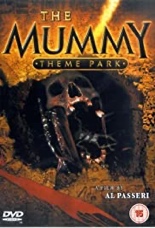
And then there’s The Mummy Theme Park. Containing all the enthusiasm its generic title can muster, it wasn’t so much released as it was dropped from director Alvaro Passeri’s rectum.
Are you ready for stunning ineptitude? (You’re not, no matter what you think. I’m just asking because I’m a polite host.)
 So in Egypt, an earthquake reveals an ancient underground city filled with mummies. Naturally, a sheik (Cyrus Elias, Roger Corman’s Frankenstein Unbound) does what anyone with do with such an archaeological find: Turn it into a theme park. And what will he name this vacation destination built to attract visitors from all reaches of the globe? The Mummy Theme Park. One assumes it wasn’t tested through focus groups.
Wanting to hire “the best” photographer ASAP to snap promo pics, the sheik — who looks like Nathan Lane dressed as Jafar on Halloween — flies Daniel Flynn (Adam O’Neil, in his only credit) and initially platonic assistant Julie (Holly Laningham, Fashionably L.A.) over from America. Daniel’s shutterbug experience seems limited to shooting topless women, but that fits right in with the sheik keeping a sizable harem, whose members sport inner-thigh “THE SHIEK” tattoos and say things like, “You think the sheik will like my boobs, hmm?”
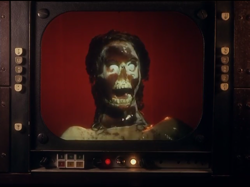
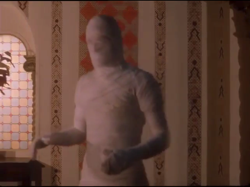 Daniel and Julie get a thorough tour of the park by train, from the lab where corpses are “reanimated” via microchip (causing one skeleton to do a ha-cha-cha dance), to the concession area where the menu includes items like “Cream of Isis” and beer is dispensed tastefully through the beard of a pharaoh. Admittedly, the many, many POV shots moving along the tracks look cool, but that’s it; everything else looks false, because it is. Cars and trains are toys, and most of the movie utilizes either green-screen or rear-projection techniques for backgrounds. Fittingly, every line of dialogue is dubbed in post, yet using tones in which people don’t actually speak.
The supposed horror finally kicks in when a flash from Daniel’s camera triggers the microchip of a mummy, startling him to come alive and attack; the science totally checks out. This mummy can walk through walls. Being pursued by this Charmin-bound man, Daniel notices the mummy staring at Julie’s breasts, so he orders her to open her blouse to distract the mummy just long enough to be doused in a bucket of acid, conveniently nearby. By gum, it works!
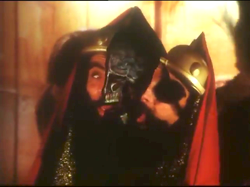 Passeri’s 1994 debut, Creatures from the Abyss (or Plankton, if you prefer), enjoys a small, but solid reputation as a cheap chunk of cheese; The Mummy Theme Park goes one better in somehow being chintzier in every conceivable regard, most notably in the effects department. No greater representation of Passeri’s poor execution exists than when things gets goopy in the last 20 minutes. It’s one thing to see a guy get sword-sliced neatly down the middle like an MGM cartoon cat; it’s another to watch as a mummy grabs the testicles of a man whose face digitally twists in response, as if a Photoshop user navigated to “Filter > Distort > Twirl.”
Resist the urge to navigate your remote to “Eject” or “Power Off,” lest you miss the different kind of goop running through The Mummy Theme Park’s final frames: romance! After decrying the park for offending the memory of the pharaohs, the aptly named Queen of Eternity (Helen Preest) cuddles with a mummy in a train car headed to, one hopes, a love nest in which he can stare at her breasts without fear or risk of dissolution. We wish the same for your psyche. —Rod Lott

 Frustration boils as panic almost immediately sets in; complains Matt, who isn’t helping matters, “Can you not be so defeatist?” (Also not a calm influence? The score’s simple tinkling of a lone piano key.)
 After everything from 1992’s
  Directed with too loose of a grip on the part of Derrick Borte (