
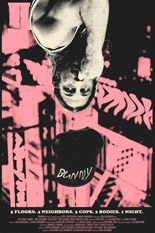

Happy birthday, Bunny! To celebrate, your boo, Bobbie, has bought you a threesome and some Molly. But that’s a package you don’t have time to open, what with the one you’re trying to keep closed around the cops: that suitcase packed with a bad guy’s folded corpse.
Played by a heretofore unknown Mo Stark, Bunny is a hustler in New York’s East Village. And Bunny is a shaggy comedy of errors that captures 12 hot and hectic hours in a melting-pot microcosm of a tenement. The film is a streetwise farce of slamming doors and unforgiving stairwells among potheads and sex workers, like if Sean Baker adapted Noises Off.
In his directorial debut, the person actually behind the camera is in front of it, too: Ben Jacobson (Blink Twice), who plays Bunny’s fast-talking best bud — so close, they sport matching promotional Basketball Diaries jerseys. Plus, this is the first feature screenplay for Jacobson, Stark and Stefan Marolachakis, making it all the more remarkable the film is able to sustain a relentless pace and impeccable comic timing.

Their jokes aren’t setup/punchline — just so sharp and knowing, they take you by surprise. For example, to an ultra-orthodox room renter (scene stealer Genevieve Hudson-Price, HBO’s The Deuce), Bunny assures her of his Jewish bona fides: “Yeah, my mother was, Bobbie’s father [is], I love Albert Brooks …” Several other lines seem destined for immortality due to their quotability, none more launch-ready than “I do love a good Smashburger!” (Trust me: It works wonders in context.)
None of Bunny would work if the characters weren’t believably authentic. Essentially, Jacobson and Stark have made a Real Movie with all their friends, and it shows. Not in the usual way of, “Well, at least it looks like they had fun” — although that, too, is true — but in they understood how to use nearly everyone in just the right part, at just the right moments, for just the right dose. (It all feels so genuine, I didn’t even recognize Mission: Impossible’s Henry Czerny in his brief role as a rabbi making house calls.) I’d say Jacobson and Stark delight in moving the many characters around a chessboard, but it’s evident they prefer to mischievously tip said chessboard to watch all the pieces slide and struggle and smooth-talk their way back into good graces.
So their ending is a bit too quick, too pat, too easily resolved. To echo a character’s statement in those closing moments, haven’t they earned it? —Rod Lott